Field notes · Enterprise knowledge

Your AI is answering from an old document.

Your company assistant sounds sure of itself, cites its source, and is quietly quoting a document three versions out of date. Here's why it happens, how to spot it, and how to stop it.

For operations leads & knowledge managers · 5 min read
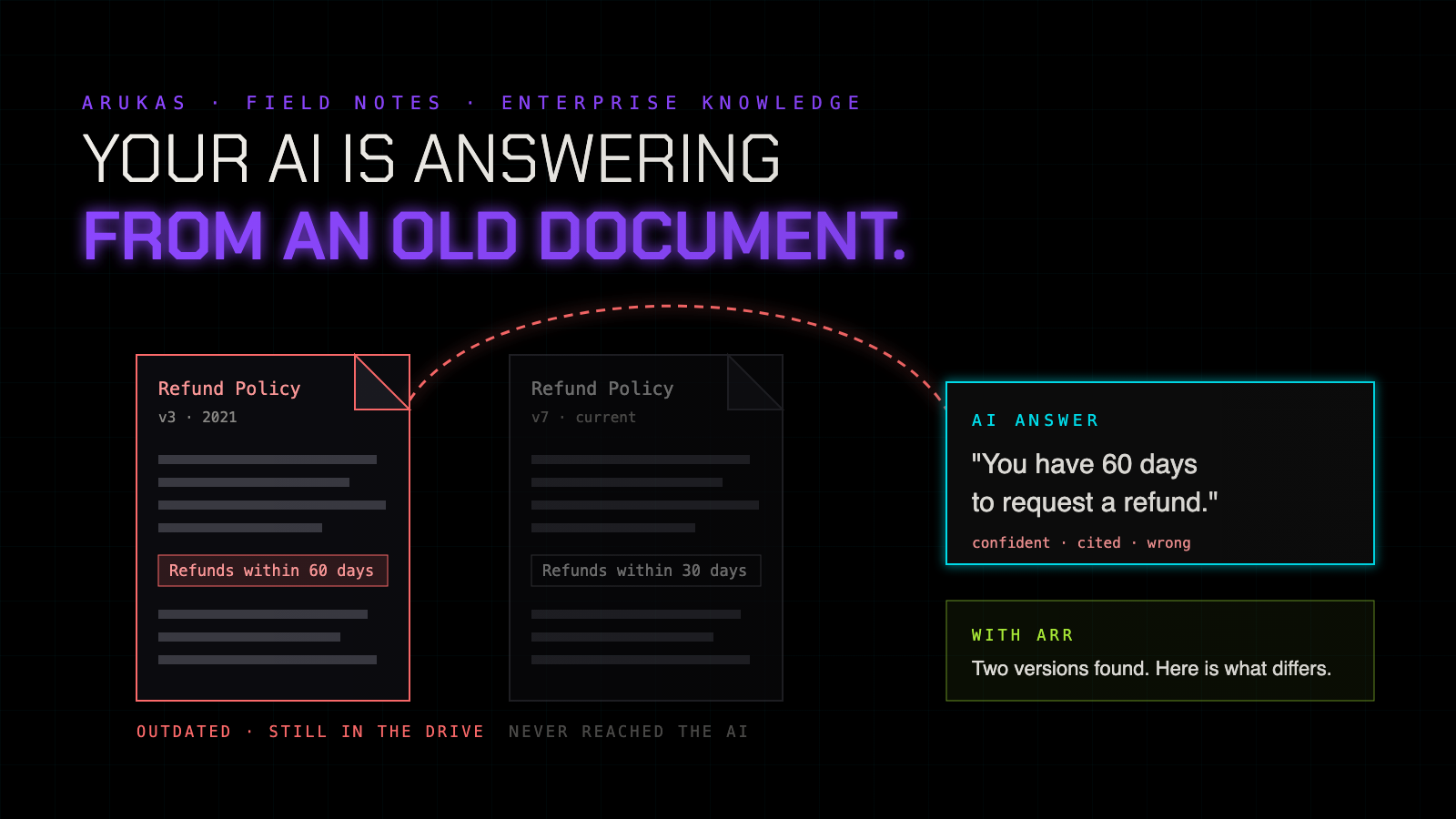
Two documents both called Refund Policy. The outdated 2021 version says refunds within 60 days and is the one the AI quotes; the current version says 30 days and never reaches the AI.
Click to open full size
The story

Two files. One line apart.

Somewhere in your shared drive there are two documents called Refund Policy. One is from 2021. One is current. Same logo, same headings, same first page. The difference is one line on page four: the old one gives customers 60 days to request a refund. The current one says 30.

Your team asks the company AI about refunds, and it answers calmly, in full sentences, with a citation:

AI answer
"You have 60 days to request a refund."
confident · cited · wrong
Why it happens

This isn't the AI being stupid.

The model did exactly what it was asked: it read the document it was handed and summarised it accurately. The mistake happened one step earlier, when the system decided which document to hand it.

Most assistants fetch a few passages that look relevant and answer from those. "Looks relevant" usually means "uses similar words", not "is the current version". And once the answer comes back, every clue a person would have used is gone: no file date, no "last edited by", no folder called ARCHIVE_DO_NOT_USE.

01

Someone asks

"How long do customers have to request a refund?"

02 · where it breaks

The wrong file is picked

The old copy happens to match the question's wording best, so it's the one the AI receives.

03

A perfect answer

The AI summarises it flawlessly. From the wrong document.

Five signs, five fixes

None of these look like errors. They look like answers.

01
The outdated twin

Ten copies, all slightly different

Your AI answers from whichever copy it reached first, and never mentions the others disagree.

✓ With ARR

Documents that share a name are paired, and your AI sees exactly what differs before it answers.

02
The update it missed

The policy changed last week

Your AI read it last month and keeps repeating the old version.

✓ With ARR

Your AI is told when something it read has changed since, so it re-checks instead of repeating stale text.

03
The echo

The same paragraph, twenty times

Duplicates flood the answer, and the one document that says something different is buried.

✓ With ARR

Each distinct passage comes back once, so the one that differs stands out.

04
One word, two meanings

Sales and finance define it differently

Your AI picks one definition of "active customer" and never mentions the other exists.

✓ With ARR

You're warned when one name is defined in several places, so the answer can say "it depends which definition you mean".

05
The link to nowhere

A procedure deleted a year ago

The handbook still points to it, and your AI answers as if it's there.

✓ With ARR

Everything that's referenced but missing is listed, so your AI can say the procedure doesn't exist.

Why cleanup isn't enough

The drive you cleaned in January is messy again by March.

Archive old files, remove duplicates, keep one source of truth: good advice, and a project that never ends. People save copies, export files and duplicate folders "just for now". You need an AI that copes with the mess, not a promise that the mess will go away.

ARR doesn't change your model. It changes what the model is handed: the right material, with the warning signs left in.

A fair caveat

We've measured these abilities in our own benchmark on code and text. We haven't yet run it on a real company's shared drive, so treat this as how ARR is built to work here, not a measured result. That's exactly what early access is for.

Try this tomorrow

The five-minute test

  1. Pick a policy you know changed this year.
  2. Ask your AI assistant about it.
  3. Check which version it quoted.

If it quoted the old one, you're not looking at an AI problem. You're looking at a retrieval problem, and that's the part ARR was built to fix.
Early access

Be one of the first teams to test ARR on real documents.

We're opening ARR to a small group first. Tell us a little about your setup and we'll be in touch when your place is ready. No payment required.

More in ARUKAS Field Notes:
Next: When legal AI gets the clause wrong
Chunking breaks meaning
Why AI coding agents break things three files away
Running parallel coding agents without them overwriting each other
Which version of the policy did your AI just apply?
AI citation errors start before the AI writes anything
Duplicate files, duplicate totals: where AI reconciliation goes wrong
What AI prior-art search doesn't tell you it missed
How ARR works →