Your AI assistant gave you a vendor total in seconds, itemised and confident. It was $13,400 too high, because one invoice had been saved to the folder twice and the AI counted both copies.

It's quarter-end. Someone asks the finance AI assistant a routine question: what was our Q3 spend with Northwind Logistics? It reads the vendor's invoice folder and answers almost immediately.
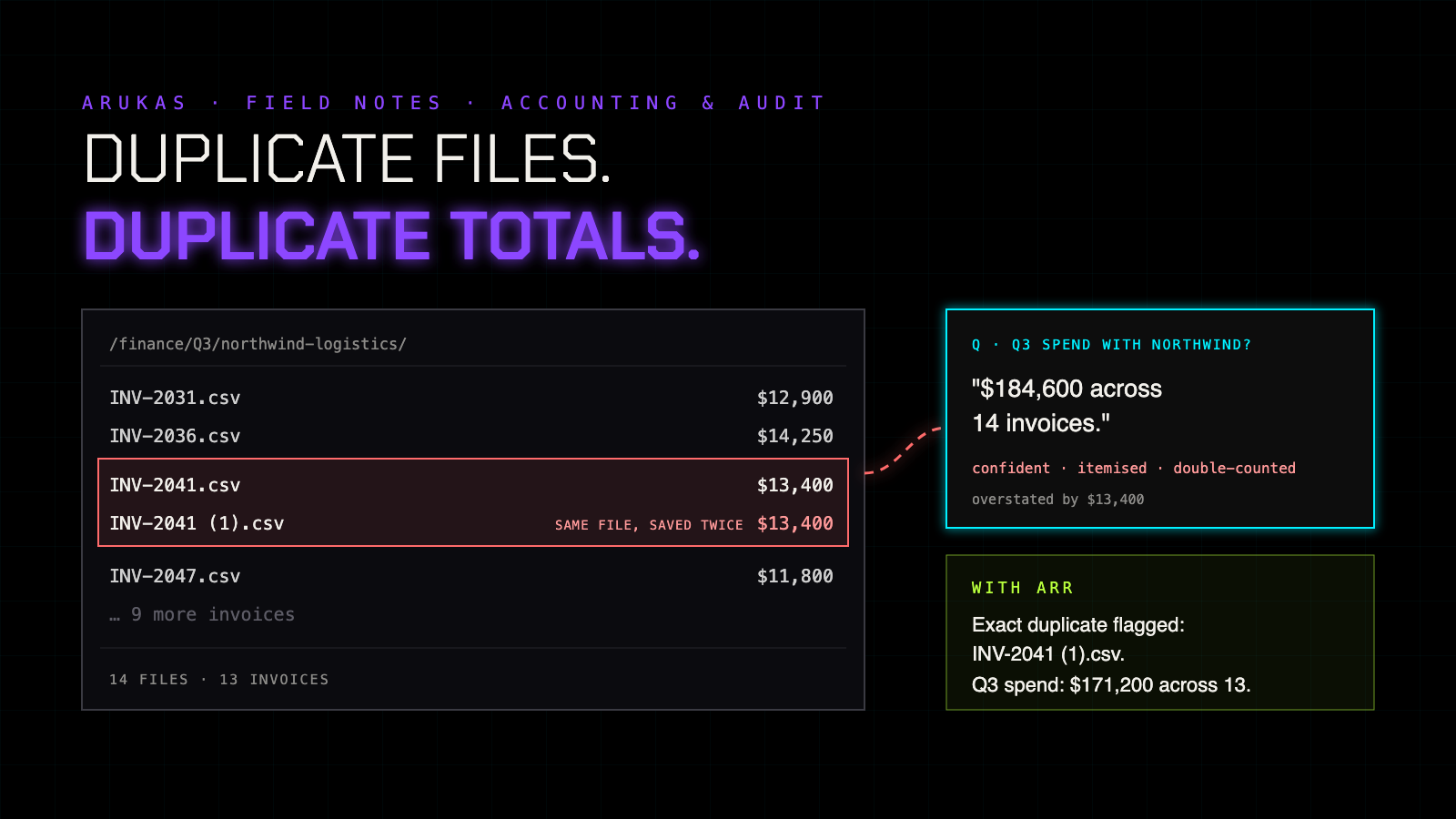
"$184,600 across 14 invoices."
There are 13 invoices. Back in August, someone downloaded INV-2041.csv from an email a second time, and it landed in the folder as INV-2041 (1).csv. Same file, same $13,400, counted twice. The real figure is $171,200.
Nobody spots it, because the answer looks thorough: every line traces to a real invoice. It only surfaces when the number fails to match the ledger, or worse, when it doesn't get checked at all.
Accounting systems are built to stop duplicates at the point of entry. AI assistants usually don't read your accounting system; they read what's around it: exports, spreadsheets, email attachments and shared folders. Those places are full of copies. A file saved twice looks like two documents, and an assistant that totals what it finds has no reason to think otherwise.
Duplicates are already one of the classic sources of overpayment and cash leakage in accounts payable (Ramp). An AI that reads every copy as new evidence makes the same mistake faster, and with more confidence.
"What was our Q3 spend with Northwind Logistics?"
The folder holds 14 files. The AI treats each one as a separate invoice.
Itemised, sourced, and $13,400 too high.
Your AI totals both copies of the same invoice or export as if they were separate records.
Exact duplicates are flagged across the whole collection, so each document is counted once.
The trial balance was re-exported after an adjustment. Your AI reports figures from one version without noticing the other differs.
The versions are paired and you see exactly which figures differ before anything is reported.
Your AI quotes the number and leaves out the adjustment noted right next to it.
When a figure and its note sit together, your AI is handed both.
A reconciliation workbook was edited after review, and there's no version history to say what changed.
ARR shows what changed between documents, even with no history or backup to compare against.
Your AI treats the two spellings as separate vendors, or misses one of them entirely.
Your AI still finds the record when the spelling is off.
Your accounting or AP system is the right place to stop a duplicate payment, and it should stay that way. But the moment an AI assistant answers questions from exports, inboxes and shared drives, it's working outside those controls, in exactly the places copies accumulate.
ARR doesn't replace your controls or your review. It changes what the AI is handed: each document once, figures with the notes beside them, a clear signal when two versions disagree, and records found even when a name is spelled differently.
ARR flags exact duplicates, the same file saved more than once. It won't catch a copy re-exported with a different layout, a near-duplicate invoice or a deliberately altered one; that's still the job of your AP controls and fraud checks. We've measured these abilities in our own benchmark on code and text, not yet on financial records, so treat this as how ARR is built to work here. That's what early access is for.
If it counted it twice, your AI isn't bad at maths. It was handed the same document as two pieces of evidence. That's the part ARR fixes.
We're opening ARR to a small group first. Tell us how your team works with its records and we'll be in touch when your place is ready. No payment required.
More in ARUKAS Field Notes:
Your AI is answering from an old document
When legal AI gets the clause wrong
Chunking breaks meaning
Why AI coding agents break things three files away
Running parallel coding agents without them overwriting each other
Which version of the policy did your AI just apply?
AI citation errors start before the AI writes anything
What AI prior-art search doesn't tell you it missed
How ARR works →