The search found the right patent family. The AI compared your design against claim 1 and said you're clear. It just compared the wrong family member, and never mentioned the continuation whose claim 1 is one word broader.

Your R&D team is about to launch a dosing pump with a piezoelectric pressure sensor. Before it goes further, someone asks the IP team's AI assistant: does our design overlap with the competitor's patent family?
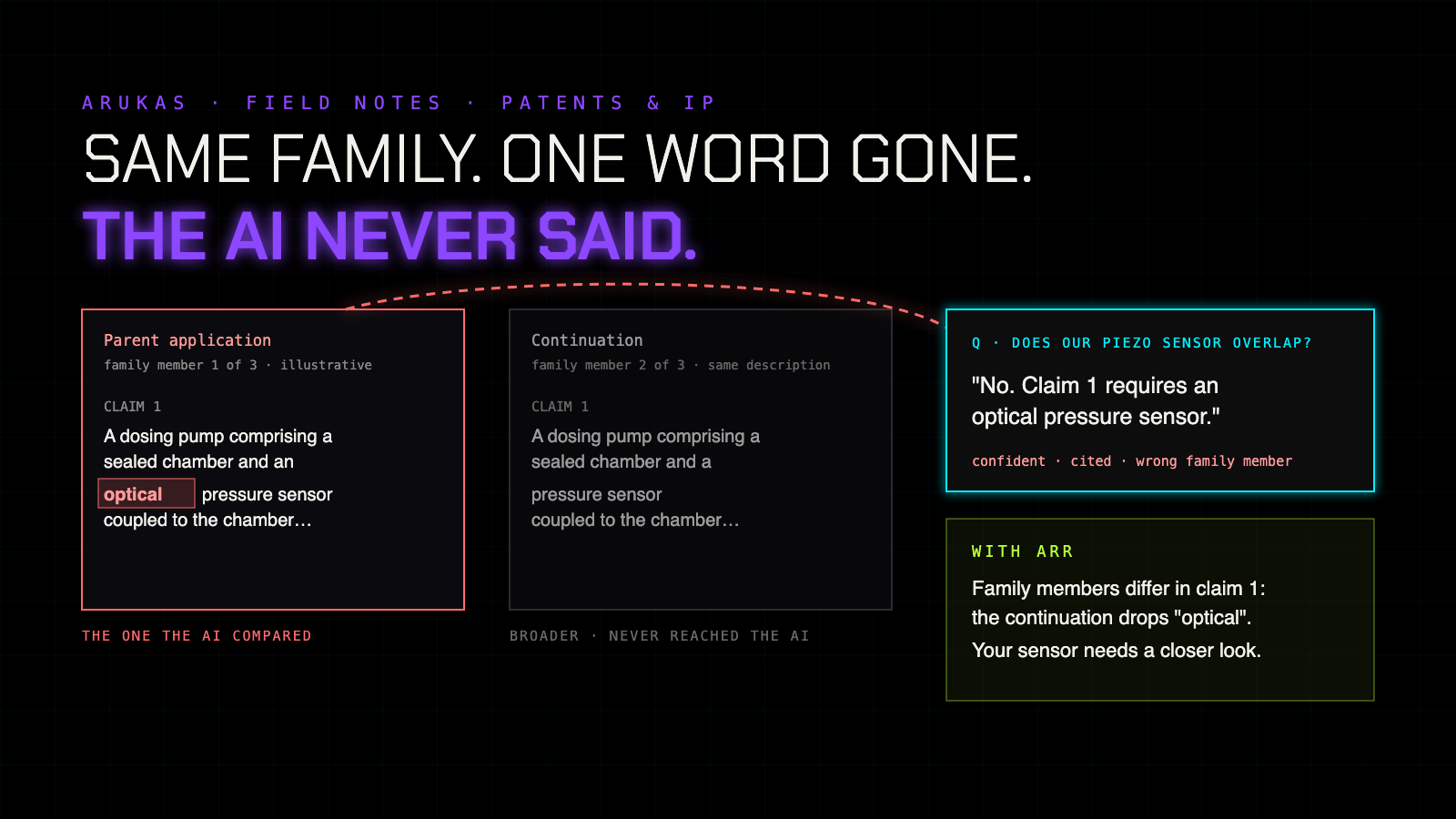
The family has three members. They share the same title and almost the same description, page after page. The AI retrieves claim 1 from the parent application and answers:
"No overlap. Their claim 1 requires an optical pressure sensor."
That's exactly what the parent says. But the continuation, filed later in the same family, claims "a pressure sensor". The word optical is gone. Your piezoelectric sensor may well sit inside that broader claim. The AI never compared it, and nothing in its answer said there was another version to compare.
People who work with AI patent tools say the same thing: a tool that fails to surface something doesn't tell you it failed, and it presents a loosely related reference with the same confidence as a strong one (Patlytics, GreyB).
Patent families make this worse. Members repeat the same description almost word for word, so an AI sees the same text again and again and stops at the first good match. The one difference that matters, a single word in one claim of one member, sits inside a wall of identical pages.
Discovery worked: the right family is in the candidate set.
Near-identical pages hide the member whose claim differs by one word.
Accurately quoted, from the wrong version of claim 1.
We'll be straight about this, because it matters more in patents than anywhere else.
Prior art often describes the same idea in completely different language. Finding it by idea is where embedding-based and specialist semantic search tools do better. In our own benchmark this is the one task where ARR is only partial. Use those tools to build your candidate set.
Once you have candidates, what matters is precision: the exact claim wording, which family member says what, how claims changed between versions, and nothing buried in duplicates. That's ARR's job, and it's where the miss in this story happens.
Your AI compares against one member and never mentions that another claims the same thing more broadly.
Family members and claim versions are paired, and you see exactly which words differ.
The same text comes back from every family member, and the one passage that's different is buried.
Each distinct passage comes back once, so the one that differs stands out immediately.
A long claim breaks across lines, and your AI reasons from the part it received.
Your AI receives the complete claim, however it's laid out.
Your AI finds each limitation somewhere in the document, but never confirms they appear together.
ARR confirms when both appear together, and exactly where.
A regional spelling or a transliterated applicant name, and your AI says the term or party isn't there.
Your AI still finds it when the spelling is off.
A careful reviewer checks that the AI's quoted claim is real and correctly read. In this story it is. What review can't easily catch is the member that was never compared, because nothing in the answer points to it. Catching that by hand means reading every member of every family, which is exactly the work the AI was meant to save.
ARR doesn't replace your search tools or your professional judgment. It changes what the AI is handed when it compares: complete claims, every version side by side with its differences, and each distinct passage once.
ARR isn't a discovery engine for art described in different words; embedding and specialist search do that better, and our own benchmark says so. It also isn't legal advice, and nothing here replaces a freedom-to-operate opinion from counsel. We've measured ARR's abilities in our benchmark on code and text, not yet on patent documents, so treat this as how ARR is built to work here. That's what early access is for.
If it answered from one member without saying so, that's the miss ARR was built to surface.
We're opening ARR to a small group first. Tell us how your team works and we'll be in touch when your place is ready. No payment required.
More in ARUKAS Field Notes:
Your AI is answering from an old document
When legal AI gets the clause wrong
Chunking breaks meaning
Why AI coding agents break things three files away
Running parallel coding agents without them overwriting each other
Which version of the policy did your AI just apply?
AI citation errors start before the AI writes anything
Duplicate files, duplicate totals: where AI reconciliation goes wrong
How ARR works →